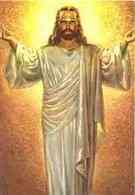
Resurrection
Resurrection
of
Jesus Christ

RESURRECTION
There are some who question the validity of
the
crucifixion and resurrection of Jesus Christ. If Jesus
Christ was not murdered and did not rise from the grave, then He is no different than any of
the wise men or prophets of other religions. Jesus' resurrection is what gives Him the
authority to say He is God and that there is no other means to experience eternal
salvation except to acknowledge Him as your Lord and Savior.
Some will argue that Jesus was never
resurrected because He did not die on the cross. We have proved that Jesus not only
suffered extreme pain, but died on the cross. See
Crucifixion page.
The following information will confirm his
resurrection. We will be using mainly logical and Biblical evidence. Of course, the
Bible more than verifies the truth of Jesus' claims, but an atheist, agnostic, or new
spiritual seeker may not believe the Bible is true. In regards to the authenticity of
Jesus being a real person who lived on this earth, His
crucifixion and resurrection will verify there was a
historical Jesus, not just a mythical person. There
are several books that cover this subject
matter. They have much documented evidence to prove the reliability of the
Bible.
If the Bible is true, then Jesus birth, Crucifixion, and
Resurrection are true. Some will argue that you can't trust the Bible because it
was written by those who believed in Jesus. If you use this argument regarding
biographies and history books (this is what the Four Gospels are like), you see
how foolish it is. Many biographies are written by people who loved the person
they are writing about, but we do not question their validity. There are those
who write about history who have their prejudices but we do not deny the facts
that are in their books.
Read on the Validity of the Bible.
Go to http://www.javaforjesus.addr.com/walk.html
for a great shockwave audiovisual presentation of the crucifixion.

| Historical Evidence |Lack of
Evidence for Resurrection |
| Lack of evidence Against the Resurrection and the Bible
Accounts |
| Invalidity of
arguments used against a true resurrection |
| Logical Reasoning
|
Historical
Evidence
The Jewish historian Josephus (AD 37-100 Aprox.) talks briefly but
matter-of-factly about Jesus. Josephus lived a
few years after Christ, he was a Pharisee who went over to the Roman camp and
wrote a history of his people. In his history he briefly mentions Jesus Christ.
"About
this time appeared Jesus, a wise man (if indeed it is right to call Him
man; for He was a worker of astonishing deeds, a teacher of such men as
receive the truth with joy), and He drew to Himself many Jews (many
also of Greeks. This was the Christ.) And when Pilate, at the denunciation
of those that are foremost among us, had condemned Him to the cross, those
who had first loved Him did not abandon Him (for He appeared to them alive
again on the third day, the holy prophets having foretold this and countless
other marvels about Him.) The tribe of Christians named after Him did not
cease to this day." (Jewish Antiquities, 18.3.3 §63 )
Most scholars agree
that the statements in italics were added later by others, most likely
Christians. I hate it when Christians use deception, lies, false claims, etc.
to quote 'help the cause'. Spreading rumors, conjectures, internet
hoaxes (even unknowingly, because they refuse to check validity first) etc. is
foolishness and many times sin, and they will be judged.
Comments on
Lack of Historical Evidence of Resurrection
The irritation of the Pharisees, helps us to
understand why the resurrection of Jesus is not discussed in the history books.
There were many writers of history at that time, but only two records of the
lives and times of the Jews of this period. One record is that of the
scriptures, the other is the record of the contemporary historian Josephus. If
there are limited historical records of the Jewish people does that mean there
was no Jewish race during Jesus' time? Maybe one of the reasons there were not
many documents regarding the resurrection is because at the time there was no
need for other documentations because the writings of the scriptures were
throughout the land.
The Pharisees certainly would not be promoting writings on the resurrection
of Jesus. The Pharisees went to great lengths to prevent any possibility of fraud in the matter
of Jesus resurrection.
They had a better knowledge of the promise of resurrection than the disciples themselves
did, and they did not want any possibility of fraudulent attempts on the part of the
disciples to gain credibility by stealing the body, then claiming it had been raised from
the dead.
(Mat 27:62-66 KJV)
They went to great pains after the resurrection of Jesus to try to hush it up, because
they knew that if the facts of the matter were broadcast, there would be no controlling
the people as they turned towards Jesus, and away from them. As the disciples went to the
city to proclaim the joyful news of the resurrected Christ, the men appointed to watch the
grave to prevent this very thing went to report to their masters.
(Mat 28:11-15 KJV)
Again, after the resurrection and ascension into heaven, the Jewish rulers still tried
to restrain the doctrine that Jesus had arisen from the dead. (Acts 4:1-3 KJV)
If the above is true, it makes logical sense that there would be a lack of
evidence.
Lack of Evidence against the
Resurrection and the Bible Accounts
Here is something that most never consider. If the crucifixion and
the resurrection of Jesus is not true, why during the early centuries is there
no documentation disproving these events other than some writings that Jesus
body was stolen. Why did those who were against Christianity make sure the body
was not stolen from the grave? Why did the opponents against Christianity
produce Jesus body to prove the Christians were deceived? Why was there not
writings proving that those who claim to have seen Jesus in resurrected form
were 'off the wall', mentally ill? Why were there no documents by the opponents
refuting the details that are documented in scripture? It isn't until over a
thousand years that the validity of the Bible is being questioned, when there is
more archaeological proof every day proving the validity of the Bible.
If the disciples died horrific deaths for believing in the resurrection of
Jesus when they actually hid his body, they were insane. If they were insane
enough to die for a lie, there should be much documentation on how crazy the
disciples were after Jesus death. There certainly is plenty of 'dirt' on other
historical figures.
Read the Logical Reasoning for more analysis on the
lack of evidence against the resurrection.
Excerpts from The Resurrection of Jesus, An Historical Fact
This document is incorrectly titled. It's basis is upon the facts of scripture,
not non-biblical historical evidence, but this document gives a good summary.
Read on the Validity of the Bible.

Invalidity of arguments used
against a True Resurrection
Mythical Argument
The mythical view asserts that Jesus' resurrection was a myth created by the early church
to maintain and grow the significance of Jesus' teaching and death. The major problem with
this view is that Paul's testimony in 1 Corinthians 15:3 demonstrates that this so-called
"myth" began early in the church. If it began early in the church, and had no
real basis in history whatsoever, it is difficult to see how it could
have been propagated for any length of time—let alone become the foundation of
the church.
Why are there no early writings denying this 'myth'? The Jewish leaders for
sure would have written against this myth.
The presence of eyewitnesses mitigates against such an interpretation. The
disciples themselves did not even believe in the resurrection of Jesus until
they actually saw Him.
Subjective Vision Theory
Others have proposed a subjective vision theory in which they claim Jesus
appeared to the disciples in dreams. From this, it is thought, the resurrection
narratives developed. The problem with this view is that the disciples do not
ever understand anything Jesus said about the resurrection during his
ministry. It is unlikely, given the disciples lack of spiritual understanding
during Jesus' life, that they would all of a sudden postulate a resurrection in
their own minds.
The disciples' condition was one of defeat and discouragement and it is
therefore difficult to think that they would have, or could have, become such
great preachers of the faith on the basis of dreams. Besides there is no
evidence that they had any dreams along these lines. And, it is difficult to
believe that they would have dreamed of Jesus' personal resurrection when all
they really had to go on was the general resurrection at the time of judgment
spoken of in Daniel 12:2 (cf. John 5:28, 29). Based upon the criterion of
Palestinian environment and their religious knowledge and heritage, it seems
unlikely that they would have dreamed such things.
Objective Vision Thesis
There is also an objective vision thesis. This proposal claims that the resurrection
appearances of Jesus were simply visions given by God to authenticate Jesus' spiritual
resurrection. This appears unlikely, given the context of 1 Corinthians 15:5 and argument
of the passage. First, in 1 Corinthians 15:3, 4 it is the same Jesus who died (i.e. the
literal man), who is said to have been buried and then risen. Second, the hope of the
believer's resurrection body is the resurrection of Jesus' body. This is clearly the
argument of the passage (cf. vv. 12, 15, 20 and esp. v. 21) and rests upon the
presupposition of a literal, bodily resurrection, not just a spiritual resurrection
(12-22).
The Christian faith is based upon a literal resurrection. This is the proof
that Jesus conquered death. If Jesus did not conquer death, then His words have
no authority.
Excerpts from The
Historical Veracity of the Resurrection Narratives.
The Hallucination Theory
The Hallucination Theory is perhaps the critics' best bet. It maintains that the
disciples
were so grieved by the loss of their teacher that they experienced visions of him and then
concluded he had risen from the dead. At first this seems reasonable since they definitely
were shaken by his death. Yet, the data does not fit the theory. Before you read
the following data it might be helpful to read the Encyclopedia Britannica's
information on
hallucinations.
1. Studies show that grief-stricken hallucinations usually are quite short. However,
the records reveal that a number of Yeshua's appearances after his death were fairly
lengthy, not just 'hallucinations' for a few minutes.
2. The encounters involved several senses.
Scientific definition of a vision:
An apparent act of vision takes place for which there is no corresponding
external object. The optic nerve has not been stimulated by any outward waves of
light or vibrations of the either, but has been excited by a purely inner
physiological cause. At the same time the sense-impression of sight is accepted
by the one who experiences the vision as completely as if it were wholly
"objective"; he fully believes the object of his vision to be actually before
him.
Definition of hallucination:
Perception of objects with no reality usually arising from disorder of the
nervous system or in response to drugs.
An unfounded or mistaken impression or notion.
Yeshua talked with the disciples. He ate with
them. He even let them touch him in order to dispel their own doubts. This
occurred in a variety of situations with others present. This was more than a
vision or hallucination.
3. On at least five occasions the Messiah appeared to seven or more of his followers.
Groups of people rarely have the same hallucinations at the same time. All of
this individuals had visual, auditory, and tactual encounters with Jesus.
There is also the more than 500 hundred that were together at one time.
4. Generally, only particular kinds of people have hallucinations. They are
normally "high-strung", highly imaginative and very nervous.
Jesus appearances were not restricted to person of any particular
psychological make-up:
a. Mary Magdalene was weeping
b. The women were afraid and astonished
c. Peter was full of remorse
d. Thomas had unbelief
e. The Emmanus pair were distracted by the events of the week
f. The disciples of Galilee were fishing
Some would argue that emotional women are more susceptible to hallucinations.
If this is true, what about Peter who was a strong and hardy fisherman who
certainly would not be considered subject to foolish emotions.
5. Hallucinations are linked in an individual's subconscious to his
particular past experiences. They are very individualistic, extremely
subjective, and in a place with nostalgic atmosphere.
It is then very unlikely, then, that two persons would have the same
hallucinations at the same time. Plus none of the individuals are documented to
have had any other 'hallucinations' or any past experiences that would have
triggered hallucinations. The appearances of Jesus were at a variety of
locations so it was not like the appearance came at a nostalgic location for
each person.
6. Those who normally have hallucinations are normally characterized as
having a belief in the idea that it expresses, and excited expectation that the
idea will somehow be realized.
None of the disciples were expecting Jesus to be resurrected. The women went
to the grave and were shocked that he was not there. Mary was actually going to
anoint Jesus body with spices. The disciples were in a house hiding from the
people because of fear. The two walking on the road were upset that Jesus had
died.
As a matter of fact, there were three separate occasions that Jesus was not
immediately recognized. (Luke 24:13-31, John 20:15, John 21:4)
6. Most people who have hallucinations normally become involved in strange
behavior, strange thoughts, and are seen as foolish.
There is no documentation that the disciples started strange practices,
immoral behavior, justified sinful behavior, or encouraged any anti-social
behavior. As a matter of fact, after the appearances of Jesus they were many
times accused of being 'too moral'.
7. The Jewish authorities were very much opposed to the vigorous preaching of the
resurrection by the early Messianic Jews. To quiet them forever all they needed to do was
produce the decaying body of Yeshua and all Jerusalem would have known that these eleven
were deceivers or insane. 'Their credibility would have disappeared instantly.
The Jewish authorities only needed to document all the 'insane behaviors' of
these 'crazy' disciples of Jesus.
8. If the disciples did have hallucinations and they were willing to die for
their belief in the resurrection, then they were insane. What is more sad than
this is that many Christians have died as martyrs for their faith and have never
seen Jesus. So they must be really insane?
The Wrong Tomb Theory
This theory claims that the women who went to pay last respects to their beloved rabbi
that early Sunday morning supposedly lost their bearings and arrived at the wrong tomb.
They noticed it was empty, and as they puzzled over the situation were greeted by a young
man who tried to explain that they were in the wrong place. They fled the scene in terror
and later concluded, along with the talmidim, that Yeshua had risen from the dead. Serious
difficulties exist with this theory too:
1. According to the records, the women had witnessed Yeshua's burial less than 72 hours
prior to their return visit and they were returning in the early morning light. It does
not seem likely that all of them would have forgotten so quickly where their teacher lay.
2. Yeshua was buried in a private garden not in a cemetery. Therefore, there is no
reason to suppose that other tombs might be confused with his.
3. At least two other talmidim (disciples) went to the tomb to verify the women's
report, since they didn't believe the women at first either. It is inconceivable that
they, too, lost their way.
4. Perhaps most significant of all is the simple fact that the authorities certainly
would have gone to the right place if they could produce the body and dispel the claims of
the growing numbers of Yeshua's followers once and for all. The authorities, however,
never took this simple step. Why? Because it was clear to all the people of Jerusalem that
the garden grave was empty. No one could produce the body because it was gone! The
ultimate result was that thousands and thousands of Jews in the area recognized Yeshua as
the long-promised Messiah.
The Stolen Body Theory
Rarely suggested by modern biblical scholars, was popular among Roman and Jewish writers
until the Middle Ages. The major premise of this theory is that Yeshua's tomb was empty
because his followers stole the body. This is highly unlikely because:
1. Jewish authorities requested a unit of tough Roman soldiers to guard the tomb and
prevent this very thing, since Yeshua had predicted his resurrection. The guards knew that
if he escaped, such an offense was punishable by their death. This is documented
in the Bible. If you do not believe the Bible, do you believe that the Jews
would have allowed Jesus body to be stolen?
2. The talmidim ("disciples") were proponents of the highest ethical
standards. Therefore, for them to have removed the body, lied about its
whereabouts and then continued to practice and preach God's holy moral code and
die as martyrs seems improbable. If the disciples died horrific deaths for
believing in the resurrection of Jesus when they actually hid his body, they
were insane. If they were insane enough to die for a lie, there should be much
documentation on how crazy the disciples were after Jesus death.
Excerpts from The Resurrection of Yeshua: Did it really Happen? By Richard C. Nichol
a Messianic Jew and
"Evidence That Demands a Verdict" by Josh McDowell.
Logical Reasoning
The way historians determine the truth of an event is by weighing the evidence.
There are three truths that most Biblical Scholars agree:
1. The tomb in which Jesus was buried was discovered empty by a group of women on the
Sunday following the crucifixion.
2. Jesus' disciples had real experiences with one whom they believed was the risen Christ.
3. As a result of the preaching of these disciples, which had the resurrection at its
center, the Christian church was established and grew.
Empty Tomb Theory
The evidence:
First, the resurrection was preached in the same city where Jesus had been buried shortly
before. Jesus' disciples did not go to some obscure place where no one had heard of Jesus
to begin preaching about the resurrection, but instead began preaching in Jerusalem, the
very city where Jesus had died and been buried. They could not have done this if Jesus was
still in his tomb--no one would have believed them.
Second, the earliest Jewish arguments against Christianity admit the empty tomb. The
Toledoth Jesu, a compilation of early Jewish writings, acknowledges this. Further, we have
a record of a second century debate between a Christian and a Jew, in which a reference is
made to the fact that the Jews claim the body was stolen. So it is pretty well established
that the early Jews admitted the empty tomb.
Why is this important? Remember that the Jews were opposed to Christianity. In
acknowledging the empty tomb, they were admitting the reality of a fact that was certainly
not in their favor. So why would they admit that the tomb was empty unless the evidence
was too strong to be denied?
Third, the empty tomb account in the gospel of Mark is based upon a source that
originated within seven years of the event it narrates. This places the evidence for the
empty tomb too early to be legendary, and makes it much more likely that it is accurate.
Fourth, the empty tomb is supported by the historical reliability of the burial story.
NT scholars agree that the burial story is one of the best established facts about Jesus.
One reason for this is because of the inclusion of Joseph of Arimethea as the one who
buried Christ. You see, Joseph was a member of the Jewish Sanhedrein, a sort of Jewish
supreme court. People on this ruling class were simply too well known for fictitious
stories about them to be pulled off in this way. This would have exposed the Christians as
fraud's. So they couldn't have circulated a story about him burying Jesus unless it was
true
Fifth, Jesus' tomb was never venerated as a shrine.
Sixth, Mark's account of the empty tomb is simple and shows no signs of legendary
development.
Seventh, the tomb was discovered empty by women. Why is this important? Because the
testimony of women in 1st century Jewish culture was considered worthless. If the empty
tomb story were a legend, then it is most likely that the male disciples would have been
made the first to discover the empty tomb.
I'm sure you've heard of the various theories used to explain away the empty tomb, such
as that the body was stolen. For example, the Jews or Romans had no motive to steal the
body--they wanted to suppress Christianity, not encourage it by providing it with an empty
tomb. The disciples would have had no motive, either. Because of their preaching on the
resurrection, they were beaten, killed, and persecuted. Why would they go through all of
this for a deliberate lie?
Resurrection Appearances
There is the evidence that Jesus' disciples had real experiences with one whom they
believed was the risen Christ. We have the testimony of the original disciples themselves
that they saw Jesus alive again.
Now, just because the disciples think they saw Jesus doesn't mean that they really did.
There are three possible alternatives:
1. They were lying
2. They hallucinated
3. They really saw the risen Christ
Which of these is most likely? Were they lying? On this view, the disciples knew that
Jesus had not really risen, but they made up this story about the resurrection. But then
why did 10 of the disciples willingly die as martyrs for their belief in the resurrection?
The hallucination theory is untenable because it cannot explain the physical nature of
the appearances. The disciples record eating and drinking with Jesus, as well as touching
him. This cannot be done with hallucinations. Further, the hallucination theory cannot
explain the conversion of Paul, three years later. Was Paul, the persecutor of Christians,
so hoping to see the resurrected Jesus that his mind invented an appearance as well? And
perhaps most significantly, the hallucination theory cannot even deal with the evidence
for the empty tomb.
Since the disciples could not have been lying or hallucinating, we have only one
possible explanation left: the disciples believed that they had seen the risen
Jesus because they really had seen the risen Jesus.
Origin of the Christian Faith
Finally, the existence of the Christian church is strong proof for the resurrection. Why
is this? Because even the most skeptical NT scholars admit that the disciples at least
believed that Jesus was raised from the grave. But how can we explain the origin of that
belief? There are three possible causes: Christian influences, pagan influences, or Jewish
influences.
Could it have been Christian influences? Craig writes, "Since the belief in the
resurrection was itself the foundation for Christianity, it cannot be explained as the
later product of Christianity." Further, as we saw, if the disciples made it up, then
they were frauds and liars--alternatives we have shown to be false.
But what about pagan influences? Isn't it often pointed out that there were many myths
of dying and rising savior gods at the time of Christianity? Couldn't the disciples have
been deluded by those myths and copied them into their own teaching on the resurrection of
Christ? First, it has been shown that these mystery religious had no major influence in
Palestine in the 1st century. Second, most of the sources which contain parallels
originated after Christianity was established.
Jewish influences cannot explain the belief in the resurrection, either. 1st century
Judaism had no conception of a single individual rising from the dead in the middle of
history. Their concept was always that everybody would be raised together at the end of
time. So the idea of one individual rising in the middle of history was foreign to them.
So we see that if the resurrection did not happen, there is no plausible way to account
for the origin of the Christian faith. We would be left with a third inexplicable mystery.

Other Resources on the Resurrection of Jesus
Christ
http://hometown.aol.com/Summersmr/Resurrection.html
http://www.leaderu.com/truth/1truth22.html
http://www.spotlights.org
It should be noted that Christianity is a
religion based upon relationship, not knowledge. It is a religion of faith not logic. The
information provided is to help answer questions, but ultimately you must believe in the
gospel accounts of the crucifixion and resurrection of Jesus Christ because you believe in
the claims of Jesus that we are sinners and we need a savior.
How To Accept Christ
|
