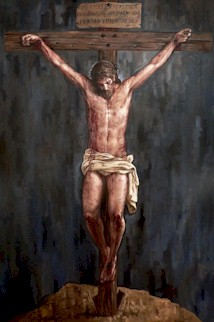
Crucifixion of Jesus
Crucifixion and Resurrection
of
Jesus Christ

(Note on graphic)
CRUCIFIXION
There are some who question the validity of
the crucifixion and
resurrection of Jesus Christ. If Jesus
Christ was not murdered and then rose from the grave, then He is no different than any of
the wise men or prophets of other religions. Jesus'
resurrection is what gives Him the authority to say He is God and that there is no other means to
experience eternal salvation except to acknowledge Him as your Lord and Savior.
Some will argue that Jesus was never
resurrected because He did not die on the cross. We will prove that Jesus not only
suffered extreme pain, but had to have died on the cross. And after His death, He was resurrected.
We will be using medical and historical information,
with some references to the Bible. Of course, the Bible more than verifies the truth of
Jesus' claims, but an atheist, agnostic, or new spiritual seeker may not believe the Bible
is true. In regards to the authenticity of Jesus being a real person who lived on this
earth, the historical information on His crucifixion and
resurrection
will verify there was a historical Jesus, not just a mythical person.
There are several books that cover this subject
matter. They have much documented evidence to prove the reliability of the
Bible.
If the Bible is true, then Jesus birth, Crucifixion, and
Resurrection are true. Some will argue that you can't trust the Bible because it
was written by those who believed in Jesus. If you use this argument regarding
biographies and history books (this is what the Four Gospels are like), you see
how foolish it is. Many biographies are written by people who loved the person
they are writing about, but we do not question their validity. There are those
who write about history who have their prejudices but we do not deny the facts
that are in their books.
Read on the Validity of the Bible.

Go to http://www.javaforjesus.addr.com/walk.html
for a shockwave audiovisual presentation of the crucifixion.

| Medical Evaluation I | Medical
Evaluation II | Historical Writings I |
| Historical Writings II |
The Hammer |
Medical Evaluation I of
Crucifixion
Jesus physical suffering started at Gethsemane. Though very rare, the phenomenon of
Hematidrosis, or bloody sweat, is well documented. This process might well produce marked
weakness and possible shock.
Jesus is brought before the Sanhedrin and Caiphus, the High Priest; He is spat upon and
struck in the face.
In the early morning, battered and bruised, dehydrated, and exhausted from a sleepless
night, Jesus is taken to Pontius Pilate and Pilate condemns Jesus to scourging and
crucifixion.
Preparations for the scourging were carried out when the Prisoner was stripped of His
clothing and His hands tied to a post above Jesus is whipped with a flagrum. This is a
short whip consisting of several heavy, leather thongs with two small balls of lead
attached near the ends of each. The heavy whip is brought down with full force again and
again across Jesus' shoulders, back, and legs. At first the thongs cut through the skin
only. Then, as the blows continue, they cut deeper into the subcutaneous tissues,
producing first an oozing of blood from the capillaries and veins of the skin, and finally
spurting arterial bleeding from vessels in the underlying muscles.
The small balls of lead first produce large, deep bruises which are broken open by
subsequent blows. Finally the skin of the back is hanging in long ribbons and the entire
area is an unrecognizable mass of torn, bleeding tissue. The Roman soldiers throw a robe
across His shoulders, place a stick in His hand, and a crown make of branches covered with
long thorns is pressed into His scalp. Again there is copious bleeding, the scalp being
one of the most vascular areas of the body.
After mocking Him and striking Him across the face, the soldiers take the stick from
His hand and strike Him across the head, driving the thorns deeper into His scalp.
Finally, the robe is torn from His back. Already having adhered to the clots of blood and
serum in the wounds, its removal causes excruciating pain, and almost as though He were
again being whipped the wounds once more begin to bleed.
The heavy patibulum of the cross is tied across His shoulders. In spite of His efforts
to walk erect, the weight of the heavy wooden beam, together with the shock produced by
copious blood loss, is too much. He stumbles and falls. The rough wood of the beam gouges
into the lacerated skin and muscles of the shoulders.
Simon of Cyrene is commanded to carry the cross. Jesus follows, still bleeding and
sweating the cold, clammy sweat of shock, until the 650 yard journey from the fortress
Antonia to Golgotha is finally completed.
Jesus quickly thrown backward with His shoulders against the wood. The legionnaire
feels for the depression at the front of the wrist. He drives a heavy, square,
wrought-iron nail through the wrists and deep into the wood. Nails driven through the
palms will strip out between the fingers when made to support the weight of the human
body. Anatomists, both modern and ancient, have always considered the wrist as part of the
hand.
The left foot is now pressed backward against the right foot, and with both feet
extended, toes down, a nail is driven through the arch of each, leaving the knees
moderately flexed. The Victim is now crucified. As He slowly sags down with more weight on
the nails in the wrists excruciating pain shoots along the fingers and up the arms to
explode in the brain -- the nails in the wrists are putting pressure on the median nerves.
As He pushes Himself upward to avoid this stretching torment, He places His full weight on
the nail through His feet. Again there is the searing agony of the nail tearing through
the nerves between the metatarsal bones of the feet.
At this point, as the arms fatigue, great waves of cramps sweep over the muscles,
knotting them in deep, relentless, throbbing pain. With these cramps comes the inability
to push Himself upward. Hanging by his arms, the pectoral muscles are paralyzed and the
intercostal muscles are unable to act. Air can be drawn into the lungs, but cannot be
exhaled. Jesus fights to raise Himself in order to get even one short breath. Finally,
carbon dioxide builds up in the lungs and in the blood stream and the cramps partially
subside. Spasmodically, he is able to push Himself upward to exhale and bring in the
life-giving oxygen.
Hours of limitless pain, cycles of twisting, joint-rending cramps, intermittent partial
asphyxiation, searing pain where tissue is torn from His lacerated back as He moves up and
down against the rough timber. Then another agony begins...A terrible crushing pain deep
in the chest as the pericardium slowly fills with serum and begins to compress the heart.
It is now almost over. The loss of tissue fluids has reached a critical level; the
compressed heart is struggling to pump heavy, thick, sluggish blood into the tissue; the
tortured lungs are making a frantic effort to gasp in small gulps of air. The markedly
dehydrated tissues send their flood of stimuli to the brain.
Finally, Jesus cries, "Father! Into thy hands I commit my spirit."
The common method of ending a crucifixion was by crurifracture, the breaking of the
bones of the legs. This prevented the victim from pushing himself upward; thus the tension
could not be relieved from the muscles of the chest and rapid suffocation occurred. The
legs of the two thieves were broken, but when the soldiers came to Jesus they saw that
this was unnecessary.
Apparently to make doubly sure of death, the legionnaire drove his lance through the
fifth interspace between the ribs, upward through the pericardium and into the heart,
"And immediately there came out blood and water." That is, there was an escape
of water fluid from the sac surrounding the heart, giving postmortem evidence that Jesus
died not the usual crucifixion death by suffocation, but of heart failure due to shock and
constriction of the heart by fluid in the pericardium.
Even if Jesus did not die from crucifixion and "giving up His spirit", he
would have been dead after His side being pierced.
This is an edited description given by
Dr. C. Truman
Davis is an Ophthalmologist. Some will argue that he is just an eye doctor.
Ophthalmologists (not Opticians) are required to go through the same medical training as a
physician.
Medical
Evaluation II of Crucifixion
The procedure of crucifixion may be summarized as follows. The patibulum was
put on the ground and the victim laid upon it. Nails, about 7 inches long and with a
diameter of 1 cm ( roughly 3/8 of an inch) were driven in the wrists . The points would go
into the vicinity of the median nerve, causing shocks of pain to radiate through the arms.
It was possible to place the nails between the bones so that no fractures (or broken
bones) occurred. Studies have shown that nails were probably driven through the small
bones of the wrist, since nails in the palms of the hand would not support the weight of a
body. In ancient terminology, the wrist was considered to be part of the hand. (Davis)
Standing at the crucifixion sites would be upright posts, called stipes, standing about 7
feet high (Edwards). In the center of the stipes was a crude seat, called a sedile or
sedulum, which served a support for the victim. The patibulum was then lifted on to the
stipes. The feet were then nailed to the stipes. To allow for this, the knees had to be
bent and rotated laterally, being left in a very uncomfortable position. The titulus was
hung above the victim's head.
There were several different types of crosses used during crucifixion. In Jesus' time,
it was most likely that the cross used was a T shaped (or tau cross,), not the popular
Latin, or t shaped cross which is accepted today (Lumpkin).
Having suffered from the beatings and flogging, Jesus suffered from severe hypovolemia
from the loss of blood. The verses above describe His dehydrated state and loss of His
strength.
When the cross was erected upright, there was tremendous strain put on the wrists, arms
and shoulders, resulting in a dislocation of the shoulder and elbow joints (Metherall).
The arms, being held up and outward, held the rib cage in a fixed end inspiratory position
which made it extremely difficult to exhale, and impossible to take a full breath. The
victim would only be able to take very shallow breaths. (This may explain why Jesus made
very short statements while on the cross). As time passed, the muscles, from the loss of
blood, last of oxygen and the fixed position of the body, would undergo severe cramps and
spasmodic contractions
With the sin of the world upon Him, Jesus suffered spiritual death (separation from the
Father ). Isaiah 59:2 says that sins cause a separation from God, and that He hides His
face from you so that He does not hear. The Father must turn away from His Beloved Son on
the cross. For the first time, Jesus does not address God as His Father (Courson).
- Shallowness of breathing causes small areas of lung collapse.
- Decreased oxygen and increased carbon dioxide causes acidic conditions in the tissues.
- Fluid builds up in the lungs. Makes situation in step 2 worse.
- Heart is stressed and eventually fails.
The slow process of suffering and resulting death during a crucifixion may be
summarized as follows:
"...it appears likely that the mechanism of death in crucifixion was suffocation.
The chain of events which ultimately led to suffocation are as follows: With the weight of
the body being supported by the sedulum, the arms were pulled upward. This caused the
intercostal and pectoral muscles to be stretched. Furthermore, movement of these muscles
was opposed by the weight of the body. With the muscles of respiration thus stretched, the
respiratory bellows became relatively fixed. As dyspnea developed and pain in the wrists
and arms increased, the victim was forced to raise the body off the sedulum, thereby
transferring the weight of the body to the feet. Respirations became easier, but with the
weight of the body being exerted on the feet, pain in the feet and legs mounted. When the
pain became unbearable, the victim again slumped down on the sedulum with the weight of
the body pulling on the wrists and again stretching the intercostal muscles. Thus, the
victim alternated between lifting his body off the sedulum in order to breathe and
slumping down on the sedulum to relieve pain in the feet. Eventually , he became exhausted
or lapsed into unconsciousness so that he could no longer lift his body off the sedulum.
In this position, with the respiratory muscles essentially paralyzed, the victim
suffocated and died. (DePasquale and Burch)
Due to the shallow breathing, the victim's lungs begin to collapse in small areas
causing hypoxia and hypercarbia. A respiratory acidosis, with lack of compensation by the
kidneys due to the loss of blood from the numerous beatings, resulted in an increased
strain on the heart, which beats faster to compensate. Fluid builds up in the lungs. .
Under the stress of hypoxia and acidosis the heart eventually fails. There are several
different theories on the actual cause of death. One theory states that there was a
filling of the pericardium with fluid, which put a fatal strain on the ability of the
heart to pump blood (Lumpkin). Another theory states that Jesus died of cardiac
rupture" (Bergsma). Another says the cause of Jesus' death "may have been
multifactorial and related primarily to hypovolemic shock, exhaustion asphyxia and perhaps
acute heart failure" (Edwards). A fatal cardiac arrhythmia may have caused the
final terminal event (Johnson, Edwards).
The average time of suffering before death by crucifixion is stated to be about 2-4
days (Tenney). There are even reported cases where the victims lived for 9 days (Lipsius).
Jesus died a relatively quick physical death. In fact, Pilate was surprised that He had
died so soon (Mark 15:44). While many of the physical signs preceding death were present,
Jesus did not die from physical causes.
Jesus gave up His life of His own accord. All of the final statements that Jesus
makes on the cross leave one with the impression that Jesus chose His time to die. His
last statement, "Into your hands I commit my Spirit" shows that
Jesus' death occurred by giving Himself up. John's gospel records Jesus' death in this
way: "With that He bowed His head and gave up
His spirit" (John 19:30b). Matthew writes: "And when Jesus had cried
out again in a loud voice, He gave up His spirit"
(Matthew 27:50).
Earlier in Jesus' ministry, Jesus made it clear that only He has the power to lay down
His life (John 10:17-18). He proved His power over death by His resurrection. Jesus gave
up His life of His own accord.
This is an edited description given by David Terasaka, M.D.
Short summary of the Crucifixion of Jesus/
http://www.bible.ca/d-crucifixion-of-Jesus.htm

Historical Evidence I
of Jesus' Crucifixion
1) Non-Jewish and non-Christian sources:
a) Tacitus, a Roman historian, in his Annals, c. AD 115, describes the Roman
Emperor Nero's actions after the great fire of Rome, c. AD 64:
Consequently, to get rid of the report, Nero fastened the guilt and inflicted
the most exquisite tortures on a class hated for their abominations, called
Christians by the populace. Christus, from whom the name had its origin,
suffered the extreme penalty during the reign of Tiberius at the hands of one of
our procurators, Pontius Pilatus, and a most mischievous superstition, thus
checked for the moment, again broke out not only in Judæa, the first source of
the evil, but even in Rome, where all things hideous and shameful from every
part of the world find their centre and become popular.
Annals 15 -44
” Mischievous Superstition”.
Exitiabilis is the latin word for mischievous. It means destructive, fatal,
deadly. So it would seem that what tacitus actually said was it was “a
destructive or fatal or deadly superstition”. He was calling Christianity
evil. So, it is obvious that he was not a Christian, thus he would not be
sharing about the death of Jesus to support the fact that there was a
historical Jesus that was killed by Pontius Pilate. Note that Tacitus is not
referring to the death of the Jesus as supersititon but the practice of
Jesus’ followers.
A
famous historian, reputed in his own days as being extremely careful and
factual, Tacitus would not have been prone to writing about a movement
without first checking the Roman archives to see if he could not get the
most accurate report possible.
He wrote his
history of Rome covering the death of Augustus to the death of Domitian,
that's 14-96 AD. He used earlier works by historians cross checking them
with each other. He sought to verify his facts, something unusual in the
writing of the time. He clearly has bias as he hated Domitian and wasn't a
great fan of Tiberius, but this would have no bearing on mentions of Christ.
Some say
that Tactitus also wrote about Hercules so his works are not valid.
Read our response to this accusation.
b) Lucian of Samosta, Greek satirist, second century AD, alludes to Christ:
The
Christians, you know, worship a man to this day--the distinguished personage who
introduced their novel rites, and was crucified on that account. . . . You see,
these misguided creatures start with the general conviction that they are
immortal for all time, which explains the comtempt of death and voluntary
self-devotion which are so common among them; and then it was impressed on them
by their original lawgiver that they are all brothers, from the moment that they
are converted, and deny the gods of Greece, and worship the crucified sage, and
live after his laws. All this they take quite on faith, with the result that
they despise all worldly goods alike, regarding them merely as common property.
Lucian
also reported that the Christians had 'sacred writings' which were frequently
read. When something affected them, "they spare no trouble, no expense."
Lucian, "The Passing of Peregrinus" 12, 13. Loeb Classical Library. English
translation by A. M. Harmon (London: William Heinemann, Ltd.; Cambridge, mass.:
Harvard University Press, 1936), pp. 13, 15.
Lucian, The Death of
Peregrine, 11–13, in The Works of Lucian of Samosata, transl. by H.W.
Fowler and F.G. Fowler, 4 vols. (Oxford: Clarendon, 1949), vol. 4
c) Thallus, a Samaritan-born historian,
wrote a history of the
Eastern Mediterranean world from the Trojan War to his own time 52 AD.
His writings are only found
as citations by others. Thallus was quoted by
Julius Africanus who wrote
about AD 221 mentioned Thallus' account of an eclipse of the sun.
On the whole world
there pressed a most fearful darkness; and the rocks were rent by an
earthquake, and many places in Judea and other districts were thrown down.
This darkness Thallus, in the third book of his History, calls, as appears to me
without reason, an eclipse of the sun.
The oddity is that
Jesus' crucifixion occurred at the Passover which was a full moon. It is not
possible for a solar eclipse to occur at a full moon. So, the event had to be a
supernatural event.
Julius Africanus,
Extant Writings, XVIII in the Ante–Nicene Fathers, ed. by Alexander
Roberts and James Donaldson (Grand Rapids: Eerdmans, 1973), vol. VI, p. 130. as
cited in Habermas, Gary R., The Historical Jesus: Ancient Evidence for the
Life of Christ, (Joplin, MO: College Press Publishing Company) 1996.
2. Jewish sources:
a) Josephus, Jewish historian (AD 37-100) wrote of Jesus:
"About
this time appeared Jesus, a wise man (if indeed it is right to call Him
man; for He was a worker of astonishing deeds, a teacher of such men as
receive the truth with joy), and He drew to Himself many Jews (many
also of Greeks. This was the Christ.) And when Pilate, at the
denunciation of those that are foremost among us, had condemned Him to the
cross, those who had first loved Him did not abandon Him (for He appeared
to them alive again on the third day, the holy prophets having foretold this
and countless other marvels about Him.) The tribe of Christians named
after Him did not cease to this day." (Jewish Antiquities, 18.3.3 §63 )
Most scholars agree
that the statements in italics were added later by others, most likely
Christians. However, there has not been any dispute regarding the accuracy
of his statement regarding the crucifixion of Jesus.
b) The Jewish Talmud (Centuries of Jewish oral tradition committed to
writing between AD 200 and AD 500),
In the Babylonian Talmud
in tractate Sanhedrin (43A), there is an interesting reference to Jesus.
On the eve of Passover they hanged Yeshu (of Nazareth) and the herald went
before him for forty days saying (Yeshu of Nazareth) is going to be stoned
in that he hath practiced sorcery and beguiled and led astray Israel. Let
everyone knowing aught in his defense come and plead for him. But they found
naught in his defense and hanged him on the eve of Passover.
The Babylonian
Talmud, transl.
by I. Epstein (London: Soncino, 1935), vol. III, Sanhedrin 43a, p.
281 as cited in Habermas, Gary R., The Historical Jesus: Ancient Evidence
for the Life of Christ, (Joplin, MO: College Press Publishing Company)
1996.
3. Conclusions from the non-biblical sources:
Historians and others that were not Christians, acknowledge the death and/or
crucifixion of Jesus.
Most Jews even to this day don't doubt that Jesus died on a
cross. They just don't recognize Him as the Messiah and that He rose from
the dead.
Some of this information is from Spotlight
on Muslim Misconceptions Website.

Historical Evidence
II of Jesus' Crucifixion
Justin Martyr, an early Christian apologist, made clear reference to a document called the
Acts of Pilate in a letter addressed to the Roman Emperor Antoninus Pius in AD 150.
Describing in detail the passion of Jesus he writes:
And the expression "They pierced my hands and
feet," was used in reference to the nails of the cross which were fixed in His hands
and feet. And after He was crucified, they cast lots upon His vesture, and they that
crucified Him parted it among them. And that these things did happen, you can ascertain
from the Acts of Pontius Pilate (First Apology 35:7-9, translation from
Rev. Alexander Roberts D.D. and James Donaldson LL.D editors, The Anti Nicene Fathers,
Vol 1, WM B. Eerdman Publishing Company, Grand Rapids, Michigan, p. 174-75).
Justin went on to list many of Jesus miracles such as the healing of
the blind and the lepers. He also credits Jesus with raising people from the dead. This
description of Jesus deeds is concluded with the following words:
And that He did those things, you can learn from the
Acts of Pilate (First Apology 48:3, Ibid. p. 179).
Justin must have assumed that this record still existed in the official Roman
archives and that Antoninus Pius could verify the facts easily. Justins whole
purpose in writing his letter was to obtain mercy from the highest official in the known
world, thus sparing the Christian community a persecution which was becoming so
commonplace. It is unlikely that Justin would ask a Roman Emperor to check a document if
he did not feel extremely confident that the document existed. Otherwise, he would be
foolishly putting his own life and reputation at risk.
There is currently not one original copy of the Acts of
Pilate. It also appears the Acts of Pilate had some mean things to say about
Christians, so later in time copies started being circulated that were edited. Even though
there is no manuscript, again there had to have been something that said what
Justin was quoting or he would have no defense.
Another early Christian leader, Tertullian (160-220AD), wrote to Roman
officials about the unusual events surrounding the trial, death and resurrection of Jesus.
Discussing a time when the Roman Senate actually considered classifying Jesus as a Roman
deity due to the miraculous nature of his life, he wrote:
To go back to the origin of such laws there was an old
decree that no one should be consecrated a god by an emperor till he had been approved by
the senate. Marcus Aemilus followed this procedure in the case of a false god, Alburnus.
This reinforces my argument that among you, godhead is conferred by human approval, if a
god does not satisfy man he does not become a god, so according to this it is for man to
show favor to God. Tiberius then in whose time the name of Christian came into the world,
when a report of this doctrine reached him from Palestine where it originated,
communicated to the senate making it clear to them that he favored the doctrine. The
senate however, because they had not examined the doctrine for themselves, rejected it.
But Tiberius stuck to his own view and threatened to execute any who accused the
Christians (Apology 5, Alexander Roberts and James Donaldson Anti-Nicene Fathers
Vol. 3, Hendrickon Publishers, Peabody, Massachusettes 1995, pp. 21-22).
It should be noted that Christianity is a
religion based upon relationship, not knowledge. It is a religion of faith not logic. The
information provided is to help answer questions, but ultimately you must believe in the
gospel accounts of the crucifixion and resurrection of Jesus Christ because you believe in
the claims of Jesus that we are sinners and we need a savior.
How To Accept Christ
Note on Graphic:
Most of the pictures that you see of Jesus on the cross are not accurate.
1. During His time, most of the crosses were in the shape of a T. The top part of
the T, patibulum, is what He would have carried.
2. He would have been naked.
3. His body would have been grotesque to look at.

THE HAMMER
by Ray Boltz
The
Hammer  
click on link to hear audio
Click on image if you need to download
RealPlayer G2
I was in the crowd the day that Jesus died
And as He hung upon the cross His mother criedI saw the crown of thorns He wore
The stripes upon His back
The water and the blood ran out
And then the sky turned black
My mind was filled with anger
My heart was filled with shame
The man brought only healing
Who could bring Him pain
Why does it seem the strong
Always victimize the weak
And suddenly I found myself
Standing to my feet
Chorus
And I cried
Who nailed Him there
This child of peace and mercy
Who nailed Him there
Come and face me like a man
Who nailed Him there
And the crowd began to mock me
I cried oh my God I just don't understand
Then I turned and saw the hammer
In my hand!
I am just a Roman soldier
An ordinary man
I love my wife and children
I do the best I can
How could I have killed Him
It must be someone else
There's got to be an answer
I just can't blame myself
Repeat Chorus
I nailed Him there
This child of peace and mercy
I nailed Him there
I am the guilty man
I nailed Him there
With my sins and transgressions
I cried oh my God now I understand
When I turned and saw the hammer...
In my hand! |
|